For remote and freelance coders
Web-based medical coding software for remote and freelance coders
Works in your browser, on any client’s cases, without EHR access. Describe the case, get the codes and the reasoning, and keep your own history.
Claire IT AI is online medical coding software for coders who work from home, often for several clients, and pay for their own tools: one account, nothing to install, the same help whichever client’s chart you have open.
- No install
- No card for the free plan
- Cancel anytime
Built by credentialed coders: meet the team
Browser-based
Nothing to install and no client system access needed.
One account across clients
Inpatient, outpatient and risk adjustment questions in the same place.
Your history stays with you
Conversations are saved to your account, and you can delete them anytime.
Try a case · first answer free
Try a case from your day, free
A remote coder’s day jumps between settings. Pick one of these, or describe the case in front of you. Nothing to install and no sign-up for the first answer.
- The same answer pipeline as the full app: retrieval, the answer, then a check of the codes against the official code set.
- No sign-up for the first answer. Your question isn’t saved to an account or our database.
- No PHI: leave out names, dates of birth and record numbers.
Pick a sample case
Describe the scenario only. No names, dates of birth or record numbers.
0/1500Claire answers in the panel at the bottom right of the page.
What gets in the way
Working remotely, without the hospital’s tools around you
Remote coders carry the same accuracy targets as on-site coders, usually with fewer tools and no one at the next desk.
“My client’s encoder isn’t available to me.”
Claire works from the scenario you describe, so no EHR, encoder login or client system is needed. Your own Code Library, Codes Dex and reference books come with the account.
“I’m paid per chart, so speed matters.”
Ask only when a case needs it. The answer comes with the reason attached, so there is no second search before you decide.
“I work alone, with no supervisor to ask.”
The reasoning stands in for a second opinion: you see how the answer was reached and can ask follow-up questions until it is clear.
Proof of the path
One tool for two settings: the same diagnosis, coded two ways
The rules change with the setting, and remote coders switch settings all day. Claire answers by the setting you choose.
The case
The provider documents chest pain and “probable GERD” and starts a trial of medication. Coded once as an outpatient visit and once as an inpatient discharge.
ICD-10-CM Official Guidelines, Section IV.H and Section II.H
Outpatient: do not code diagnoses documented as “probable”, “suspected”, “questionable”, “rule out” or similar; code the symptoms instead. Inpatient: if the diagnosis documented at discharge is qualified as “probable”, “suspected” or similar, code the condition as if it existed.
- 1
Outpatient: code the symptom
In the outpatient setting, a diagnosis documented as probable, suspected or likely is not coded. Code the condition to the highest degree of certainty, here the chest pain.
R07.9 - 2
Inpatient: code it as if established
For an inpatient admission, an uncertain diagnosis documented at the time of discharge is coded as if it existed.
K21.9 - 3
Check against your client’s policy
Claire shows the rule for each setting; your client’s own coding policy still applies.
- Result: R07.9 for the outpatient visit; K21.9 for the inpatient discharge.
How it works
Three steps, on any client’s case
- Step 1
Describe the case
Type or paste the clinical scenario, without identifiers.
For you: “Outpatient visit, chest pain, probable GERD.”
- Step 2
Claire shows codes and the path
Codes, sequencing and the guidelines behind them, with the codes checked against the official code set.
For you: R07.9, with the outpatient rule that decides it.
- Step 3
You decide and copy
Check the reasoning, make the call and copy the codes into your workflow.
For you: You confirm against the client’s record and policy.
Compared
Web-based medical coding software, compared
Remote coders usually choose between paying for an encoder themselves, free lookup sites and a general chatbot.
| Feature | Claire IT AI | Your own encoder subscription | Free code lookup sites | General AI chatbot |
|---|---|---|---|---|
| Explains why the code fits | ||||
| ICD-10-CM, PCS and HCPCS | ||||
| Checks suggested codes against the official code set | ||||
| Works without client system access | ||||
| Free plan to start |
A general comparison of tool types, not of any one product; features and prices vary by vendor. Claire’s PCS and HCPCS need Pro or above; CPT needs the CPT add-on.
Trust
Built to support your judgment, not replace it
Claire IT AI shows its reasoning so you can check it, and it never needs patient identifiers to help.
No PHI, by design
Describe the clinical scenario without names, dates of birth or record numbers. Our terms ask that no PHI is ever entered.
You make the call
Claire explains and suggests. The final code is always the coder’s decision.
Codes checked
Claire checks the codes in its answers against the official code set, and corrects or flags a code that does not exist or does not fit.
Current code sets
Updated to the FY2027 ICD-10-CM and ICD-10-PCS code sets and the October 2026 HCPCS quarter.
The question we hear most
“Is my clients’ data safe?”
Claire never needs it. You describe the clinical scenario without names, dates of birth, record numbers or other identifiers, and our terms ask that no PHI is ever entered. Check your client’s policy on outside reference tools too.

Plans for remote coders
Most remote coders choose Pro: ICD-10-CM, ICD-10-PCS and HCPCS with 4M tokens a month. Premium doubles that to 8M and adds file uploads for heavy multi-client months.
What's included:

Basic code lookups
Limited chat queries
Query Generator Tool (Beta)

File uploads
Claire with CPT Access
Priority Support
Code Libraries
ICD-10-CM
HCPCS
ICD-10-PCS
CPT
What's included:

Pro code lookups
Limited chat queries
Query Generator Tool (Beta)
File uploads
Claire with CPT Access
Priority support
Code Libraries
ICD-10-CM
HCPCS
ICD-10-PCS
CPT
What's included:
Paste clinical notes for coding
File uploads (text, PDFs)
Search and save favorite codes
Priority support
Claire with CPT Access
Code Libraries
ICD-10-CM
HCPCS
ICD-10-PCS
CPT
What's included:
Everything in Premium
Unlimited tokens
Early access to new features
Priority support
Claire with CPT Access
Code Libraries
ICD-10-CM
HCPCS
ICD-10-PCS
CPT
FAQ
Questions coders ask
Short, straight answers. Can't find yours? Ask Claire a case above.
Do I need to install anything?
No. Claire runs in your web browser; there is nothing to download or install.
Can I use it for several clients?
Yes. One account works across all your clients. Never paste PHI from any of them: describe the clinical scenario only.
Does it replace my client’s encoder?
No. It is a second check that explains the code. Follow each client’s policies and systems for the final coding.
What does it cost?
The Free plan is $0 with 500K tokens a month for ICD-10-CM. Pro, Premium and Unlimited are paid monthly or yearly, and CPT access is a yearly add-on. Current prices are in the plans above.
Can I cancel anytime?
Yes. Cancel from your account at any time and your plan stays active until the end of the period you paid for. Payments are not refunded for partial periods.
Does it work on a phone or tablet?
Claire is a web app that adapts to smaller screens, so it runs in a phone or tablet browser. There is no separate mobile app to install.
Is it allowed by my client’s compliance rules?
Check your client’s policy on outside reference tools. Claire needs no PHI and no access to client systems, which is usually what those policies are about.
Officially Licensed & Partnered With Industry Leaders
Claire is officially licensed and partnered with leading medical authorities, ensuring trusted standards in coding and CDI.


Supporting compliant, audit-ready healthcare workflows.
Keep reading
From the Claire blog
 AIJun 29, 2026
Remote Medical Coding with AI Assistance: Best Practices for Productivity and Accuracy
A practical guide for remote inpatient coders using AI-powered coding assistants to overcome isolation challenges, maintain quality, and achieve productivity goals from home.
Read article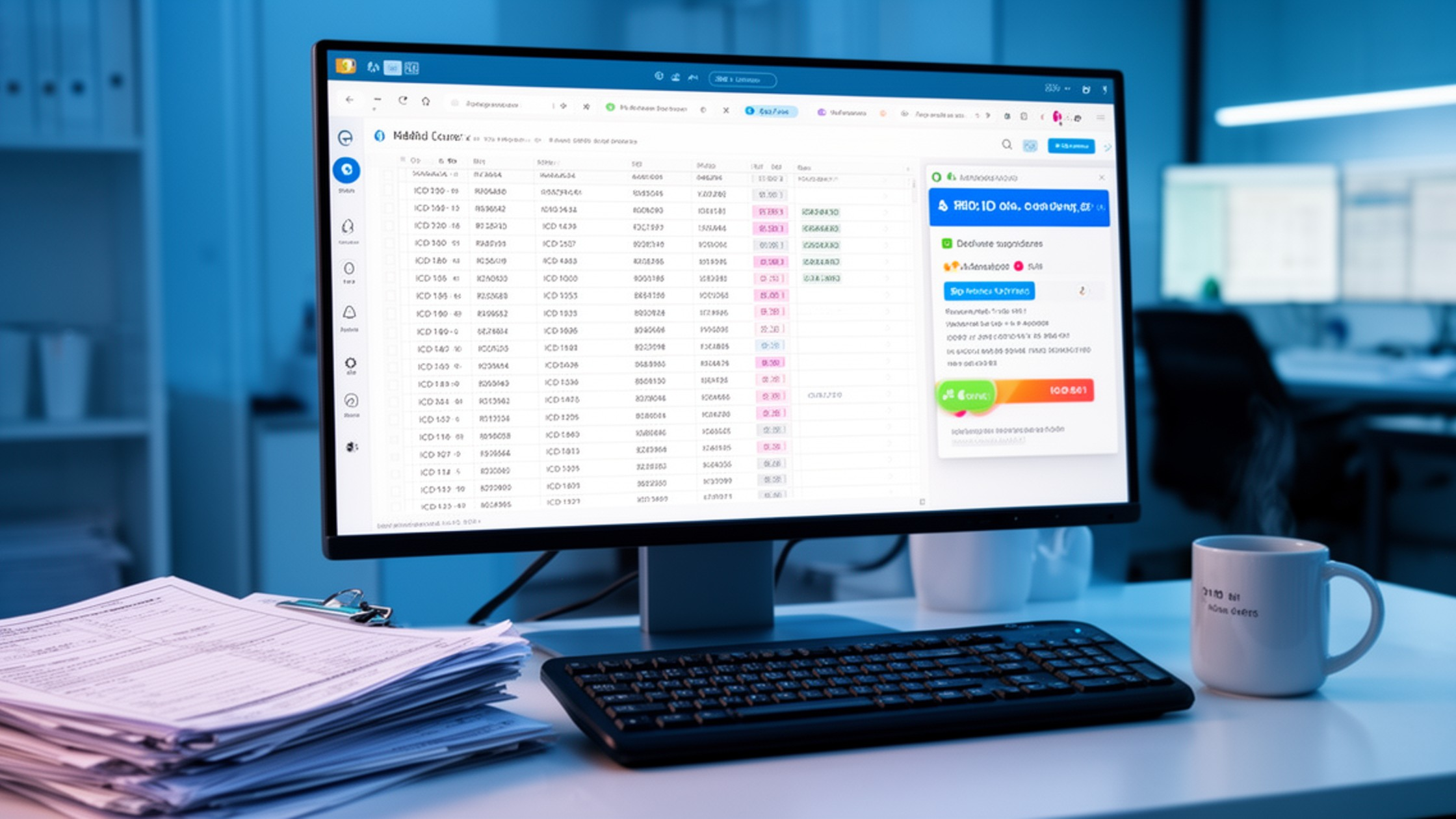 AISep 26, 2026
Affordable AI Medical Coding Tools for Remote Coders 2026
The market is split between enterprise contracts and a handful of tools a solo coder can actually buy. A side-by-side look at CLAIRE, Fathom, CureMD, Rivet, CodaMetrix and Nym across pricing model, code sets, integration and compliance - and why most published accuracy figures are self-reported rather than audited.
Read article AIMar 6, 2026
What Is a Medical Coding AI Assistant? A Practical Guide for Remote Coders
A practical guide to medical coding AI assistants for remote coders and certification students, how they work, key capabilities, and what to look for.
Read article AISep 25, 2026
Is ChatGPT Accurate for Medical Coding? Findings
What the peer-reviewed benchmarks actually measured: 33.9% exact-match on ICD-10-CM and 49.8% on CPT in the Mount Sinai study, 14-22% in otology, fabricated codes across every model tested, and why laterality, modifiers and rare codes are where general-purpose LLMs break.
Read article AIJun 30, 2026
How to Resolve Complex Medical Coding Cases Without Supervisor Escalation
A practical framework for independent problem-solving of challenging inpatient coding scenarios using clinical reasoning, official guidance, and AI-assisted research.
Read article
Bring the same coding help to every client.
Start free in your browser: 500K tokens a month, no card, nothing to install.

The AI Medical Coding Assistant,
Built for Real-World Clinical Workflows


© 2026 CLAIRE IT AI. All rights reserved.