For inpatient coders
Hospital coding software that shows inpatient coders the guideline path
Describe a case. Claire returns ICD-10-CM and ICD-10-PCS codes and the sequencing, with the guideline behind each step. You decide.
Claire IT AI is hospital coding software for the coder working long inpatient charts against a quota: it reads the scenario you describe, explains which condition is principal and why, and checks the codes it suggests against the official code set.
- No PHI needed
- Free plan: 500K tokens a month
- No card to start
Built by credentialed coders: meet the team
ICD-10-CM and ICD-10-PCS
Diagnoses and procedures, updated to the FY2027 code sets on October 2, 2026.
The guideline behind the answer
Answers walk through the Official Guidelines that decide the code and the sequence.
You decide
Claire explains and suggests. It never assigns a final code for you.
Try a case · first answer free
Try an inpatient case, free
Pick a case inpatient coders ask about every week, or describe your own. Claire answers the way it does inside the app: codes, sequence and the reasoning.
- The same answer pipeline as the full app: retrieval, the answer, then a check of the codes against the official code set.
- No sign-up for the first answer. Your question isn’t saved to an account or our database.
- No PHI: leave out names, dates of birth and record numbers.
Pick a sample case
Describe the scenario only. No names, dates of birth or record numbers.
0/1500Claire answers in the panel at the bottom right of the page.
What gets in the way
The inpatient questions that slow a chart down
The hard part of an inpatient chart is rarely finding a code. It is deciding which condition leads, which notes apply and when to ask the provider.
“Which condition is principal on this chart?”
Claire walks through the principal diagnosis rules for the scenario you describe, including two conditions that equally meet the definition, and names the guideline that decides it.
“Did I miss a Code first or an Excludes1 note?”
Look up any code in Claire’s Code Library or Codes Dex and its Tabular List instructional notes are shown with it, including the ones printed at the category and chapter level, so a Code first, Use additional or Excludes1 note does not slip past.
“Should I query the provider?”
Ask Claire what the documentation is missing: “urosepsis”, for example, has no default code and needs a query. The built-in Query Generator then drafts a non-leading, single-issue query you can review and send.
Proof of the path
Sepsis due to E. coli UTI, step by step
One inpatient case the way Claire works it: the scenario, the guideline that decides the sequence, and the codes.
The case
A patient is admitted with sepsis due to an E. coli urinary tract infection. Both are present on admission. The provider documents no acute organ dysfunction.
ICD-10-CM Official Guidelines, I.C.1.d.4
If the reason for admission is sepsis or severe sepsis and a localized infection, such as pneumonia or cellulitis, a code for the underlying systemic infection should be assigned first and the code for the localized infection should be assigned as a secondary diagnosis.
- 1
Identify the reason for admission
The sepsis, with a localized infection (the UTI) as its source.
- 2
Apply the sepsis sequencing guideline
When the reason for admission is sepsis and a localized infection, the systemic infection is coded first and the localized infection second.
- 3
Pick the codes
Sepsis due to Escherichia coli first, then urinary tract infection, site not specified. N39.0 carries a Use additional code note to identify the infectious agent, so B96.20 follows it. No organ dysfunction is documented, so no severe sepsis code is added.
A41.51N39.0B96.20 - Result: A41.51 as principal diagnosis, then N39.0 and B96.20, all present on admission.
How it works
Three steps from chart to code
- Step 1
Describe the case
Type or paste the clinical scenario, without identifiers.
For you: “Admitted for sepsis due to E. coli UTI, no organ dysfunction.”
- Step 2
Claire shows codes and the path
Codes, sequencing and the guidelines behind them, with the codes checked against the official code set.
For you: A41.51 first, then N39.0 and B96.20, with guideline I.C.1.d.4.
- Step 3
You decide and copy
Check the reasoning, make the call and copy the codes into your workflow.
For you: You confirm against the record and enter it in your encoder.
Compared
How Claire compares with the tools inpatient coders use today
Most inpatient coders already have an encoder. Claire sits beside it to explain the choice.
| Feature | Claire IT AI | Traditional encoder | Computer-assisted coding | General AI chatbot |
|---|---|---|---|---|
| Explains why a code or sequence is right | ||||
| Checks suggested codes against the official code set | ||||
| ICD-10-PCS | ||||
| Works without EHR access | ||||
| Free plan to start |
A general comparison of tool types, not of any one product; features vary by vendor. Claire’s ICD-10-PCS needs the Pro plan or above.
Trust
Built to support your judgment, not replace it
Claire IT AI shows its reasoning so you can check it, and it never needs patient identifiers to help.
No PHI, by design
Describe the clinical scenario without names, dates of birth or record numbers. Our terms ask that no PHI is ever entered.
You make the call
Claire explains and suggests. The final code is always the coder’s decision.
Codes checked
Claire checks the codes in its answers against the official code set, and corrects or flags a code that does not exist or does not fit.
Current code sets
Updated to the FY2027 ICD-10-CM and ICD-10-PCS code sets and the October 2026 HCPCS quarter.
The question we hear most
“Will this slow me down?”
You ask only when a chart needs it: a sequencing call, a PCS root operation, a note you are unsure of. An answer usually arrives in well under a minute, with the reasoning attached, so there is nothing else to look up before you decide.

Plans for inpatient coders
Inpatient coders usually choose Pro: it adds ICD-10-PCS and HCPCS to ICD-10-CM, with 4M tokens a month. Unlimited removes the token cap for high-volume coders.
What's included:

Basic code lookups
Limited chat queries
Query Generator Tool (Beta)

File uploads
Claire with CPT Access
Priority Support
Code Libraries
ICD-10-CM
HCPCS
ICD-10-PCS
CPT
What's included:

Pro code lookups
Limited chat queries
Query Generator Tool (Beta)
File uploads
Claire with CPT Access
Priority support
Code Libraries
ICD-10-CM
HCPCS
ICD-10-PCS
CPT
What's included:
Paste clinical notes for coding
File uploads (text, PDFs)
Search and save favorite codes
Priority support
Claire with CPT Access
Code Libraries
ICD-10-CM
HCPCS
ICD-10-PCS
CPT
What's included:
Everything in Premium
Unlimited tokens
Early access to new features
Priority support
Claire with CPT Access
Code Libraries
ICD-10-CM
HCPCS
ICD-10-PCS
CPT
FAQ
Questions coders ask
Short, straight answers. Can't find yours? Ask Claire a case above.
Does Claire replace my encoder?
No. Use it alongside your encoder to check codes and sequencing and to see the guideline behind them. The encoder remains your system of record.
Does it support ICD-10-PCS?
Yes, on the Pro plan and above. Procedure questions are covered, including root operation choices such as Revision versus Replacement, and the code library includes the official ICD-10-PCS definitions.
Can it calculate CC/MCC or DRG impact?
Not as a calculator. Claire can explain how CC and MCC capture and DRG assignment work for a scenario, but it does not group a case or compute a DRG.
Understanding SOI, ROM and CC/MCCHow do I use it without sharing PHI?
Describe the clinical scenario without names, dates of birth, record numbers or other identifiers. Claire needs the clinical facts, not the patient.
How accurate is it, and who checks the answers?
Claire checks the codes in its answers against the official code set, and corrects or flags a code that does not exist or contradicts the scenario. Every answer shows its reasoning so you can verify it, and the final code is always your decision.
Is it updated for the FY2027 code changes?
Yes. The ICD-10-CM and ICD-10-PCS code sets were updated to FY2027 on October 2, 2026, and the code year used in an answer follows the date of service.
FY2027 ICD-10-CM update explainedDoes it use Coding Clinic?
No. Answers are based on the ICD-10-CM and ICD-10-PCS Official Guidelines and code sets. Check your own licensed copy of Coding Clinic where it applies.
Can my whole coding team use it?
Yes, each coder uses their own account. If you lead a team, see Claire for coding teams and book a demo to plan a rollout.
Claire for coding teamsOfficially Licensed & Partnered With Industry Leaders
Claire is officially licensed and partnered with leading medical authorities, ensuring trusted standards in coding and CDI.


Supporting compliant, audit-ready healthcare workflows.
Keep reading
From the Claire blog
 AIJul 6, 2026
SOI and ROM in APR-DRG: How CC/MCC Coding Moves Scores
Severity of illness and risk of mortality scores are the invisible architecture behind hospital quality measurement. How CC and MCC coding drives SOI and ROM, and how to capture the conditions that are commonly missed.
Read article Medical CodingOct 29, 2026
Choosing principal diagnosis: two equal conditions
Learn how to choose the principal diagnosis when two conditions equally meet the definition using ICD-10-CM Section II.C, with examples and query tips.
Read article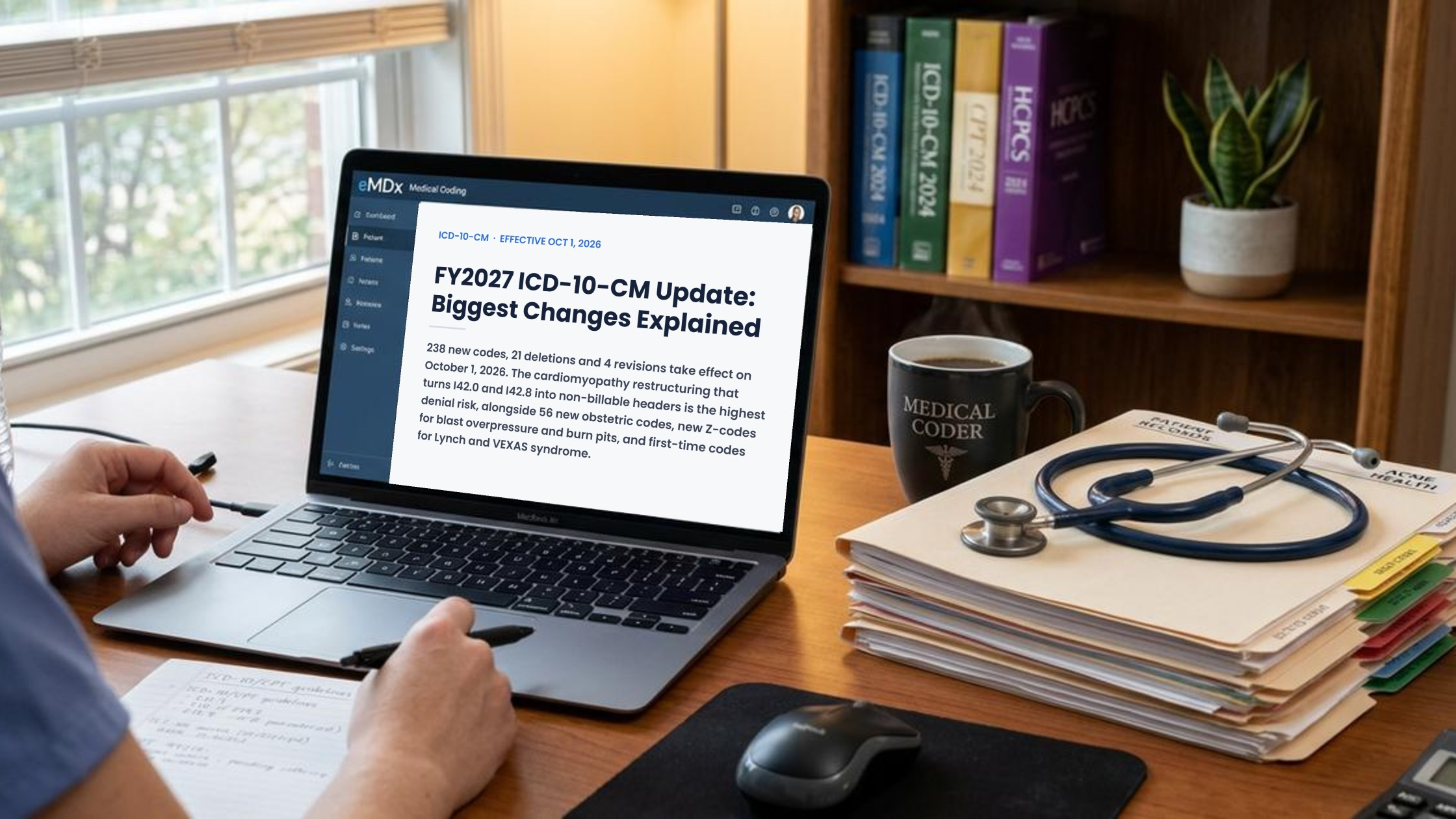 Medical CodingSep 23, 2026
FY2027 ICD-10-CM Update: New, Deleted and Revised Codes
238 new codes, 21 deletions and 4 revisions take effect on October 1, 2026. The cardiomyopathy restructuring that turns I42.0 and I42.8 into non-billable headers is the highest denial risk, alongside 56 new obstetric codes, new Z-codes for blast overpressure and burn pits, and first-time codes for Lynch and VEXAS syndrome.
Read article AIJul 7, 2026
Revision vs Replacement Joint Procedures: Critical ICD-10-PCS Coding Differences for Inpatient Coders
A detailed guide to distinguishing joint revision from replacement procedures with root operation selection, device value assignment, and clinical scenario analysis.
Read article AINov 6, 2026
Which AI tools speed up inpatient chart coding?
Discover which AI tools speed up inpatient chart coding, from CAC to CDI query assistants, and what to check for accuracy and HIPAA compliance.
Read article Medical CodingJul 15, 2026
Claire AI vs Traditional Computer-Assisted Coding: What Is the Difference?
Claire AI differs from traditional CAC systems in three ways: clinical reasoning over keyword matching, collaboration over replacement, and educational explanations that build coder knowledge. A full comparison vs CAC, autonomous, and manual coding.
Read article
Code your next inpatient chart with the guideline path in front of you.
Start free with 500K tokens a month and no card. Upgrade to Pro when you need ICD-10-PCS.

The AI Medical Coding Assistant,
Built for Real-World Clinical Workflows


© 2026 CLAIRE IT AI. All rights reserved.